
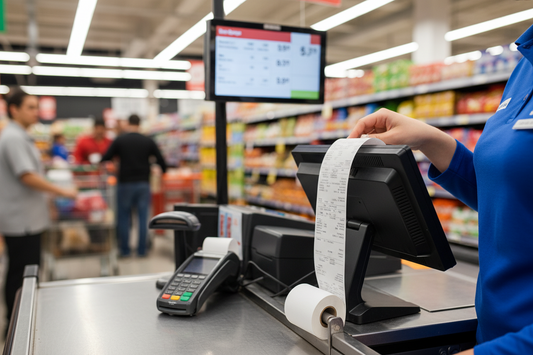
Whether you operate a retail store, restaurant, convenience shop, or market stall, a reliable cash register and receipt roll setup remains an essential part of daily business operations. While digital payments continue to grow in popularity, businesses still need efficient systems for recording transactions, issuing receipts, and managing cash.
In this guide, we'll answer some of the most common questions about cash registers, receipt paper, and related retail essentials.
Cash Register and Receipt Roll
A cash register is a machine used to calculate sales, store cash securely, and record transactions. Most modern cash registers are connected to point-of-sale (POS) systems and use receipt rolls to print customer receipts.
Receipt rolls are typically made from thermal paper like these, which uses heat rather than ink to create printed text. Businesses choose receipt rolls based on factors such as paper width, roll length, and durability.
Selecting the right receipt roll helps ensure smooth operations, fewer paper changes, and professional-looking receipts for customers.
How Many Receipts Per Roll?
The number of receipts a roll can produce depends on several factors:
· The length of the receipt
· The size of the paper roll
· The amount of information printed
· Whether logos or promotional messages are included
As a general estimate, a standard thermal receipt roll like this one can produce anywhere from 150 to 400 receipts. Short receipts containing only transaction details will allow more receipts per roll, while longer receipts with itemized purchases use more paper.
Businesses with high transaction volumes often prefer larger rolls because they reduce downtime caused by frequent replacements.
What Type of Paper Is Inexpensive?
Several types of paper are known for being cost-effective:
Thermal Paper
Thermal paper is widely used for receipt rolls because it does not require ink or toner. This makes it an economical choice for businesses that print large numbers of receipts.
Bond Paper
Bond paper is often used in offices and provides a good balance between quality and affordability.
Recycled Paper
Many recycled paper products are competitively priced and offer environmental benefits.
Lightweight Paper
Lower-weight paper stocks generally cost less and are suitable for high-volume printing applications where durability is not a major concern.
The most economical option depends on the intended use, printing method, and required lifespan of the document.
Which Paper Is Thicker, 20 or 24?
When discussing paper thickness, the number typically refers to the paper weight.
· 20 lb paper is lighter and thinner.
· 24 lb paper is heavier and thicker.
A 24 lb paper offers several advantages:
· Improved durability
· Better print quality
· Reduced show-through from the opposite side
· More professional appearance
However, 20 lb paper is often more economical and works well for everyday printing needs. For most receipt rolls, thermal paper specifications are usually measured differently, but the same principle applies: higher-weight paper is generally thicker.
How Much Money Should a Cash Register Have?
The amount of money kept in a cash register depends on the business type and expected transaction volume.
Many businesses start each day with a "float" that typically ranges from:
· $100 to $300 for small shops
· $300 to $500 for busy retail stores
· More for high-volume businesses
The float usually contains a mix of bills and coins to make change throughout the day.
The ideal amount balances two goals:
1. Having enough cash to serve customers efficiently.
2. Minimizing security risks associated with keeping excessive cash on-site.
Businesses should regularly reconcile cash drawers and remove excess cash when necessary.
What Do British People Call Cash Registers?
In the United Kingdom, people often refer to a cash register as a:
· Till
· Cash till
· Checkout till
The word "till" is commonly used in retail environments. For example, a store employee may say they are "working on the till" or ask customers to proceed to the next till.
Modern POS systems are also increasingly common, but the term "till" remains widely used throughout Britain.
Do Businesses Still Use Cash Registers?
Yes, businesses still use cash registers, although many have evolved into sophisticated POS systems.
Modern cash registers often include:
· Touchscreen interfaces
· Inventory management
· Payment processing
· Sales reporting
· Customer tracking features
Small businesses, cafés, food trucks, and independent retailers continue to rely on cash registers because they provide a simple and effective way to process transactions.
Even businesses that accept digital payments still require systems for issuing receipts and recording sales.
What Is Another Name for a Cash Register?
Several terms are used interchangeably with cash register, including:
· Point-of-sale (POS) terminal
· Till
· Checkout register
· Sales register
· Electronic cash register (ECR)
The specific term often depends on the industry and technology being used.
For example, modern retail operations frequently refer to their systems as POS terminals because they perform many functions beyond simply storing cash.
Is It Cheaper to Buy Paper in Bulk?
In most cases, yes.
Buying receipt rolls or office paper in bulk offers several benefits:
· Lower cost per unit
· Reduced shipping expenses
· Fewer emergency reorders
· Better inventory management
Businesses that regularly use receipt paper can achieve significant savings by purchasing larger quantities.
Before buying in bulk, consider:
· Storage space requirements
· Paper shelf life
· Expected usage rates
For busy businesses, bulk purchasing is often one of the simplest ways to reduce operating costs.
What Is the Slang for a 20 Pound Note?
In British slang, a £20 note is sometimes called a "score."
For example: "Can you lend me a score?"
This means asking for twenty pounds.
Like many slang terms, usage varies by region and generation. While "score" remains widely understood, many people simply refer to it as a twenty-pound note.
Why Is $0.10 Called a Dime?
The term dime comes from the old French word disme, meaning "tenth part."
When the United States introduced decimal currency, the ten-cent coin represented one-tenth of a dollar. Over time, the spelling evolved from disme to dime.
Today, the dime remains one of the most commonly used coins in North America and continues to represent ten cents, or $0.10.