
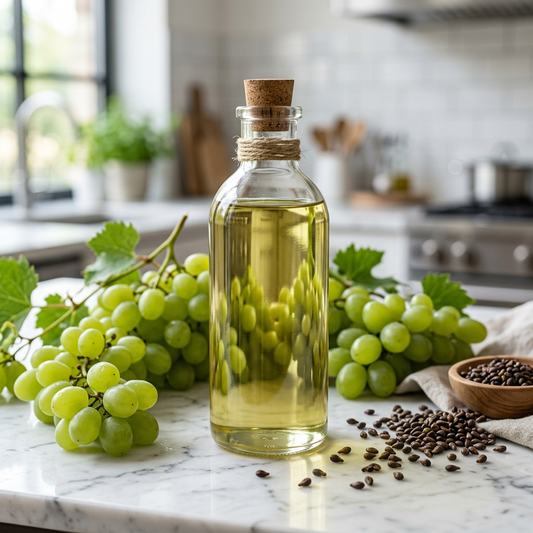
Grapeseed oil is a light, neutral-tasting vegetable oil made from the seeds of grapes, often collected as a by-product of winemaking. It is popular for frying, salad dressings, marinades, skincare, and hair care because of its mild flavour and lightweight texture.
However, grapeseed oil is also high in polyunsaturated fats, particularly omega-6 fatty acids, which raises questions about its health effects, cooking stability, and how it compares with olive oil and other everyday oils.
In this guide, you will learn how to use grapeseed oil safely, whether it is suitable for high-heat cooking, how to store it, and which alternatives may better suit your needs.
Can I Fry with Grapeseed Oil?
Yes, grapeseed oil can be used for frying because refined varieties generally have a high smoke point, often around 420–445°F (215–230°C). Its neutral taste also makes it suitable for foods where you do not want the oil to dominate the flavour.
It works well for:
- Pan-frying chicken, vegetables, and seafood.
- Sautéing mushrooms, onions, and peppers.
- Shallow-frying cutlets and other breaded foods.
- Preparing stir-fries and quick-cooking meals.
However, the smoke point is not the only factor that determines whether an oil is suitable for frying. Grapeseed oil is rich in polyunsaturated fats, which are less stable under prolonged high heat than oils richer in monounsaturated fats.
For frequent or extended deep-frying, consider high-oleic sunflower oil or refined olive oil. Avoid repeatedly reusing any frying oil, and discard it if it becomes unusually dark, thick, foamy, or develops an unpleasant smell.
Practical tip: Use grapeseed oil for occasional frying, keep the temperature controlled, and avoid heating it until it smokes.
What Oil Do Italians Use for Frying?
Olive oil is an important part of Italian cooking, but Italians use different oils depending on the dish, region, cooking method, and household preference.
Common choices include:
- Extra virgin olive oil: Often used for dressings, finishing dishes, sautéing, and some frying.
- Refined olive oil: Has a milder flavour and is suitable for higher-temperature cooking.
- Sunflower oil: Used for frying when a neutral flavour is preferred.
- Peanut oil: Used in some kitchens for frying because of its relatively high smoke point and neutral taste.
For example, extra virgin olive oil can be used to fry vegetables, prepare fritters, or cook fish. Its smoke point varies with quality and composition, but it is generally suitable for many everyday cooking tasks when the temperature is controlled.
There is no single oil used by everyone in Italy. The best choice depends on the food, desired flavour, and cooking temperature.
Which Is Better for Hair, Olive Oil or Grapeseed Oil?
Both oils can be useful for hair care, but the better choice depends on your hair type and what you want to achieve.
|
Feature |
Grapeseed oil |
Olive oil |
|
Texture |
Lightweight |
Generally heavier |
|
Best suited for |
Fine hair and lightweight conditioning |
Dry, coarse, or thick hair |
|
Hair feel |
Less likely to feel greasy when used sparingly |
Can provide a richer, more coating feel |
|
Scalp application |
May suit people who prefer lighter oils |
May feel too heavy for some scalps |
Grapeseed oil can help coat hair strands, improve manageability, and reduce the feeling of dryness. Olive oil may be more suitable for thick or coarse hair that benefits from a richer oil.
Neither oil can guarantee hair growth or reverse hair loss. If you have a sensitive scalp, test a small amount first and discontinue use if irritation develops.
Should You Refrigerate Grapeseed Oil After Opening?
Refrigeration is generally not necessary for refined grapeseed oil, but it can help preserve quality in warm environments.
Grapeseed oil is relatively high in polyunsaturated fats, making it more susceptible to oxidation than oils that contain more monounsaturated fats. Heat, light, and air can speed up this process.
To store it properly:
- Keep the bottle tightly sealed after each use.
- Store it in a cool, dark cupboard away from the stove.
- Choose a dark glass bottle or another protective container when possible.
- Refrigerate it if your kitchen is consistently warm or if the product label recommends refrigeration.
- Check the smell and taste before use, particularly if the bottle has been open for a long time.
Refrigerated grapeseed oil may become cloudy or thicker. This is generally a normal response to cooler temperatures and does not automatically mean the oil has spoiled.
Storage tip: Whether you refrigerate it or keep it in a cupboard, minimize exposure to heat, light, and air.
Which Country Has the Healthiest Olive Oil?
No single country can claim to produce the healthiest olive oil in every case. Italy, Spain, Greece, Portugal, and other Mediterranean countries produce excellent olive oils.
The health value of olive oil depends more on its quality, freshness, processing, and storage than on the country printed on the label.
When shopping, look for:
- Extra virgin classification: This indicates oil produced using mechanical methods that meets defined chemical and sensory standards.
- Recent harvest information: Fresher oil is generally preferable because its quality can deteriorate over time.
- Protected packaging: Dark bottles or tins help limit exposure to light.
- Proper storage: The oil should be protected from heat and air.
- A reputable producer: Reliable sourcing and quality controls matter more than a country's reputation alone.
Extra virgin olive oil is a particularly useful choice because it provides monounsaturated fats and naturally occurring polyphenols. Replacing some saturated fats with unsaturated fats can support cardiovascular health as part of a balanced diet.
Which Is Better for Skin, Coconut Oil or Grapeseed Oil?
Grapeseed oil and coconut oil can both moisturize the skin, but they have different textures and may suit different needs.
Grapeseed oil is relatively lightweight and contains linoleic acid, which contributes to the skin's lipid barrier. Some people prefer it because it spreads easily without leaving a particularly heavy coating.
Coconut oil is richer and more occlusive, meaning it helps reduce moisture loss from the skin. It may be useful for dry areas such as elbows, knees, and legs, although it can clog pores or worsen breakouts in some people.
|
Skin concern |
Potentially suitable option |
|
Lightweight daily moisturization |
Grapeseed oil |
|
Very dry body skin |
Coconut oil |
|
Skin prone to clogged pores |
Grapeseed oil may be preferable, but individual reactions vary |
|
Sensitive skin |
Either may cause irritation; patch testing is recommended |
Neither oil replaces sunscreen, and neither should be considered a proven treatment for acne, eczema, or other skin conditions. Choose fragrance-free products when possible and stop using an oil if it causes irritation.
Is Grapeseed Oil for High-Heat Cooking?
Grapeseed oil can tolerate relatively high temperatures, especially when it is refined. Its smoke point is commonly reported around 420–445°F (215–230°C), although the exact value varies by product and processing method.
It can be used for roasting, sautéing, and short periods of frying. However, a high smoke point does not necessarily mean an oil is the most stable choice for prolonged heating.
Because grapeseed oil contains a high proportion of polyunsaturated fats, extended exposure to high temperatures can increase oxidation.
For high-heat cooking, consider these options:
- Refined olive oil: A versatile choice with a relatively high proportion of monounsaturated fats.
- High-oleic sunflower oil: Designed to contain more oleic acid than conventional sunflower oil, improving its oxidative stability.
- Avocado oil: Refined varieties can have a high smoke point and a mild flavour.
Choose an oil based on the cooking method, and avoid letting it smoke or reusing it repeatedly.
Which Is Healthier, Canola Oil or Grapeseed Oil?
Both canola oil and grapeseed oil contain unsaturated fats, but their fatty acid profiles differ.
|
Nutritional feature |
Canola oil |
Grapeseed oil |
|
Monounsaturated fats |
Moderate to high |
Relatively low |
|
Polyunsaturated fats |
High |
Very high |
|
Omega-3 ALA |
Contains some |
Contains very little |
|
Flavour |
Mild |
Neutral |
|
Best use |
Everyday cooking and dressings |
Dressings, sautéing, and occasional frying |
Canola oil is often a practical everyday choice because it provides a balance of monounsaturated and polyunsaturated fats, including alpha-linolenic acid (ALA), a plant-based omega-3 fatty acid.
Grapeseed oil supplies more linoleic acid, an essential omega-6 fatty acid. Omega-6 fats are not inherently harmful; the important consideration is the overall dietary pattern and the types of fats they replace.
For general everyday use, canola oil is a versatile and affordable option. Grapeseed oil remains useful when you want a neutral flavour or a lightweight oil for specific recipes.
Why Avoid Grapeseed Oil?
Grapeseed oil is not inherently unhealthy, but there are several reasons to use it thoughtfully.
1. It is high in omega-6 fatty acids. Grapeseed oil contains substantial amounts of linoleic acid, an essential omega-6 fatty acid. Your body needs this fat, but it is important to maintain a balanced diet that includes a variety of fats rather than relying heavily on a single oil.
2. It can oxidize during cooking. Polyunsaturated fats are more vulnerable to oxidation when exposed to heat, air, and light. Repeatedly heating grapeseed oil, especially during deep-frying, can accelerate the formation of unwanted oxidation products.
3. Quality varies between products. Extraction methods, refining, packaging, and storage conditions can influence oil quality. Poorly stored oil may develop an unpleasant smell or flavour.
4. It may not offer the same benefits as extra virgin olive oil. Extra virgin olive oil contains naturally occurring polyphenols and other antioxidant compounds that are associated with its potential health benefits.
This does not mean you must avoid grapeseed oil completely. It can fit into a balanced diet when used appropriately, particularly for occasional cooking and cold dishes.