
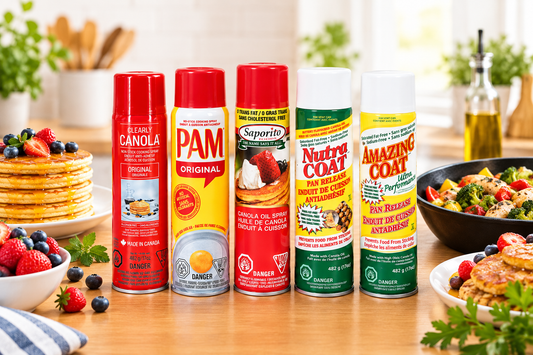
Cooking spray is a convenient kitchen staple designed to create a thin layer of oil on cookware, helping prevent food from sticking. Unlike pouring oil directly into a pan, a spray distributes a very small amount across a broad surface.
People often choose cooking spray because it is quick, easy to measure and useful when they want to reduce the amount of added fat in a recipe. A typical aerosol spray contains cooking oil along with ingredients that help it disperse properly, such as an emulsifier and propellant.
But is cooking spray actually better than oil? The answer depends on how you use it and what you are cooking.
Why do people use cooking spray instead of oil?
The biggest advantage is control. A short spray can coat a frying pan or baking tray with a very thin layer of oil, whereas pouring oil can make it easier to use more than intended.
Cooking spray is also convenient for:
- Greasing cake tins and baking trays
- Preventing eggs from sticking
- Roasting vegetables
- Cooking pancakes and French toast
- Helping breaded foods develop a crisp exterior
- Lightly coating food so seasonings adhere
Because the amount used can be very small, cooking spray can reduce calories compared with a tablespoon of oil. However, the "zero calorie" claim found on some labels can be misleading if you spray for longer than the tiny serving size specified on the package.
Here are some great options to consider:
· Clearly Canola - Non-Stick Cooking Spray - 17oz
· Amazing Coat - Pan Release - Ultra
What should you use if you don't have cooking spray?
You can simply use regular cooking oil.
Pour a small amount into the pan and spread it with a pastry brush, paper towel or silicone brush. For baking, lightly grease the surface with oil or butter, depending on the recipe.
A refillable oil mister is another option. It can provide a fine coating without requiring a conventional aerosol can.
For most everyday cooking, there is no need to have cooking spray specifically. Oil works perfectly well; the main difference is how easily and evenly it can be distributed.
Can you spray cooking spray directly on food?
Some cooking sprays are specifically labelled for direct application to food. For example, certain olive oil and avocado oil sprays are marketed for spraying directly onto food before cooking.
However, always follow the instructions on the particular product. Aerosol cooking sprays are pressurized and may also be flammable. They should never be sprayed onto a hot pan, near an open flame or directly into a hot oven.
If your goal is simply to lightly coat vegetables, potatoes or other food, check the label first to make sure the product is intended for that purpose.
Does cooking spray have bad chemicals?
The word "chemical" can make cooking spray sound more alarming than it is. Cooking sprays are made from ingredients with specific functions, and approved food ingredients are used in these products.
Depending on the brand, an aerosol spray may contain oil, lecithin, an anti-foaming ingredient and a propellant. Some newer products use different dispensing systems or avoid certain additives altogether.
If you prefer a simpler ingredient list, look for a spray made from a single cooking oil with minimal additional ingredients, or use a refillable pump sprayer filled with your preferred oil.
People with food allergies should also read the label carefully, as some sprays contain soy-derived lecithin.
Is cooking spray worse than oil?
Not necessarily. Cooking spray and cooking oil are closely related because the main ingredient in many sprays is oil.
The difference is primarily the delivery method.
A spray allows you to apply a very thin layer, while bottled oil makes it easier to measure a larger amount. Nutritionally, the underlying oil matters. A canola oil spray, for example, is not nutritionally identical to an olive oil spray.
Cooking spray may be useful when you need only a light coating. Bottled oil is often preferable when you need enough fat for sautéing, frying or flavour.
What do Italians use instead of butter?
Italian cooking traditionally relies heavily on olive oil, particularly extra-virgin olive oil, rather than butter in many dishes.
Olive oil can be used for sautéing vegetables, making sauces, roasting ingredients and finishing dishes. Butter is still used in Italian cuisine, especially in northern regions and in dishes such as risotto, but olive oil is an important everyday cooking fat.
If you are looking for an alternative to butter, extra-virgin olive oil is often a simple and flavourful choice.
Is it healthy to cook with cooking spray?
Cooking spray can fit comfortably into a healthy diet. Its main advantage is that it can help you use less added fat when a recipe only requires a coating for the pan.
However, cooking spray is not automatically healthier simply because it comes in a can. The ingredients vary by product, and using large amounts can still add calories and fat.
For everyday cooking, focus on the type of oil, amount used and cooking method rather than assuming spray is always healthier.
What is the healthiest cooking spray you can use?
There is no single healthiest spray for everyone, but a good choice is one based on a nutritionally favourable oil with a short ingredient list.
Olive oil spray is a strong option for moderate-temperature cooking and dishes where you enjoy its flavour. Avocado oil spray can be useful for higher-temperature cooking, particularly when the product is designed for that purpose.
If you want maximum control over ingredients, a refillable pump sprayer containing your preferred oil is another practical choice.
Is cooking spray the same as cooking oil?
Not exactly, although the two can contain the same oil.
Cooking oil is the oil itself. Cooking spray is a delivery system that turns oil into a fine coating. Aerosol sprays may contain additional ingredients to help the product dispense and spread evenly.
Think of it this way: cooking oil is the ingredient; cooking spray is one way of applying that ingredient.
What's a good alternative to cooking spray?
The simplest alternative is a small amount of oil applied with a brush or paper towel.
Other options include:
- Butter or ghee for appropriate recipes
- A refillable oil mister
- Parchment paper for baking
- A well-seasoned cast-iron or carbon-steel pan
- A quality non-stick pan
Your best option depends on the recipe. Parchment, for example, can be excellent for roasting or baking but obviously cannot replace oil when oil is an important part of the dish.
Is cooking spray healthier than olive oil?
Usually, it is more accurate to say that cooking spray can help you use less olive oil, rather than saying the spray itself is healthier.
A quick spray may deliver considerably less oil than a tablespoon poured from a bottle. That can mean fewer calories. But if you spray continuously, the difference becomes smaller.
Olive oil also provides flavour and can be an excellent source of monounsaturated fat. So there is no need to avoid bottled olive oil simply because cooking spray is available.
What oil does Gordon Ramsay use for frying?
Gordon Ramsay has frequently demonstrated cooking with olive oil, although the best oil depends on the particular dish and cooking temperature. His recipes and cooking demonstrations use different oils for different purposes, so it is not accurate to suggest that he uses one oil exclusively.
For frying, choose an oil based on the heat, flavour you want and type of frying. Neutral oils are often practical for high-heat frying, while olive oil can be excellent when its flavour suits the dish.
Can I just use oil instead of cooking spray?
Absolutely. In most recipes, you can replace cooking spray with a small, measured amount of oil.
For a frying pan, start with about a teaspoon and spread it evenly. For baking, brush a thin coating over the surface. If a recipe calls for cooking spray simply to prevent sticking, regular oil will generally accomplish the same basic job.
The bottom line is that cooking spray is a convenience, not a necessity. It can make it easier to apply a thin layer of oil and control portions, while regular oil offers more versatility and often more flavour. Choose whichever fits your recipe, cooking method and personal preferences—and check the ingredient label if keeping additives to a minimum matters to you.