
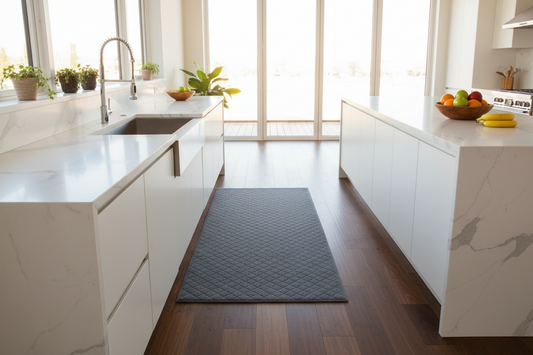
If you spend long hours standing—whether in a kitchen, workshop, retail space, or office—you’ve probably heard about anti-fatigue mats. They’re often marketed as a simple solution to reduce discomfort and improve posture. But do they actually live up to the hype? Let’s break it all down in a practical, no-nonsense way.
Where to put an anti-fatigue mat?
Placement is key. You’ll get the most benefit when the mat is positioned where you stand the longest.
Common locations include:
· In front of the kitchen sink or stove (refer to these options)
· At a standing desk
· Behind a retail counter
· In workshops or garages
Avoid placing them in high-traffic walkways unless they have beveled edges to reduce tripping risks.
How to stop anti-fatigue matting sliding on floor?
A sliding mat can be frustrating—and dangerous. Here are simple fixes:
· Use non-slip backing or rubberized mats like this
· Place the mat on a clean, dry surface
· Add double-sided carpet tape
· Use a non-slip rug pad underneath
If slipping persists, consider upgrading to a higher-quality mat designed for your specific flooring type.
Do anti-fatigue mats really work?
Yes, anti-fatigue mats do work—but with some caveats. Their effectiveness depends on the quality of the mat, how it’s used, and the environment.
Anti-fatigue mats are designed to encourage subtle movements in your leg muscles. Instead of standing completely still on a hard surface like tile or concrete, your body naturally makes micro-adjustments to maintain balance. This improves blood circulation and reduces muscle fatigue over time.
That said, they’re not magic. They won’t eliminate all discomfort, especially if your posture is poor or you’re standing for extremely long periods without breaks.
Just make sure you’re opting for a anti-slip one just like this one we have.
What is the best thickness for an anti-fatigue mat?
The ideal thickness typically falls between 3/8 inch (about 10 mm) and 3/4 inch (about 19 mm).
· Thin mats (under 10 mm): Better for tight spaces but offer less cushioning
· Medium thickness (10–19 mm): The sweet spot for most users
· Thicker mats (20 mm+): Provide more cushioning but may feel unstable or become a tripping hazard
For most home or office use, a medium-thickness mat strikes the best balance between comfort and stability.
Should you wear shoes on an anti-fatigue mat?
Yes, but it depends on the environment.
· With shoes: Common in workplaces like retail or industrial settings
· Barefoot or socks: Popular in kitchens or at home workstations
High-quality mats are designed to work either way. However, standing barefoot on a mat with good cushioning can feel more comfortable and allow better natural movement.
Are gel or foam fatigue mats better?
Both gel and foam mats have their strengths.
Foam mats:
· Lightweight and affordable
· Provide decent cushioning
· May compress over time
Gel mats:
· Offer better durability
· Maintain shape longer
· Typically more comfortable for extended use
If you’re standing for long periods daily, gel mats are usually the better investment. For occasional use, foam mats can be perfectly adequate.
What is the lifespan of anti-fatigue mats?
Most anti-fatigue mats last between 1 to 5 years, depending on quality and usage.
Factors that affect lifespan:
· Material (gel lasts longer than foam)
· Frequency of use
· Weight load
· Exposure to moisture or chemicals
Signs it’s time to replace your mat include flattening, cracking, or loss of cushioning.
Is an anti-fatigue mat worth it?
For many people, absolutely.
If you stand for more than a couple of hours a day, an anti-fatigue mat can:
· Improve comfort
· Reduce aches and pains
· Boost productivity
They’re a relatively low-cost upgrade compared to ergonomic chairs or specialized footwear, making them a practical investment.
Can anti-fatigue mats be cut to size?
Some mats can be cut, but not all.
· Foam mats: Often easier to trim
· Rubber or gel mats: Usually not recommended to cut
Cutting a mat can damage its structure and reduce durability. If you need a specific size, it’s better to buy one that fits your space from the start.
Are thicker anti-fatigue mats better?
Not necessarily.
While thicker mats provide more cushioning, they can also:
· Feel unstable
· Increase the risk of tripping
· Be harder to move or clean
The best mat is one that balances comfort with stability. More thickness doesn’t always mean better performance.
When to use anti-fatigue mats?
Use them whenever you’re standing in one place for extended periods—generally more than 30 minutes at a time.
They’re especially helpful for:
· Cooking or washing dishes
· Working at a standing desk
· Assembly line or retail work
· DIY or workshop tasks
Can mold grow under rubber flooring?
Yes, mold can grow under rubber mats if moisture gets trapped underneath.
To prevent this:
· Lift and clean under the mat regularly
· Ensure the floor is completely dry before placing the mat
· Avoid leaving mats in damp areas for long periods
Proper maintenance goes a long way in preventing mould and odours.
Can you put a regular rug over an anti-fatigue mat?
You can, but it’s not ideal.
Adding a rug on top:
· Reduces the mat’s effectiveness
· Can create a slipping hazard
· Limits the subtle movement that reduces fatigue
If aesthetics are a concern, look for anti-fatigue mats designed with decorative finishes instead.